

“Life would be much more pleasant if one could carry with them, wherever they went, the flavors and aromas of their mother’s kitchen.”
— Laura Esquivel, Like Water for Chocolate
Seeing Muslims, Christians and Jews share a plate of food and a cultural tradition creates a sense of peace, harmony and unity around a table.
That mixture of emotions becomes possible through Hummus the Movie, the documentary by Israeli filmmaker, photojournalist and film producer Oren Rosenfeld, now screening in Bogotá cinemas.
Rosenfeld, who is also serving this year as a jury member in the international category at BOGOCINE, has built an extensive career as a photojournalist and filmmaker. He covered the Second Palestinian Intifada and other major events around the world, and has produced, directed and filmed documentaries and investigative reports for outlets including the BBC, National Geographic and the History Channel.
In 2010, he founded Holy Land Productions, a documentary production company operating in the Middle East and Africa. In 2022, he received his second Emmy Award for his camera work on VICE News’ Battle for Jerusalem. In 2024, together with his partner Rebecca Shore, he presented Marathon Mom, about ultra-Orthodox athlete and mother Beatie Deutsch, as well as Surviving Nova, a production that received a Peabody Award and was nominated for an Emmy.
But it is in Hummus the Movie that Rosenfeld finds a particularly intimate way of telling the story of a region through one of its most iconic foods.
Beyond the Recipes
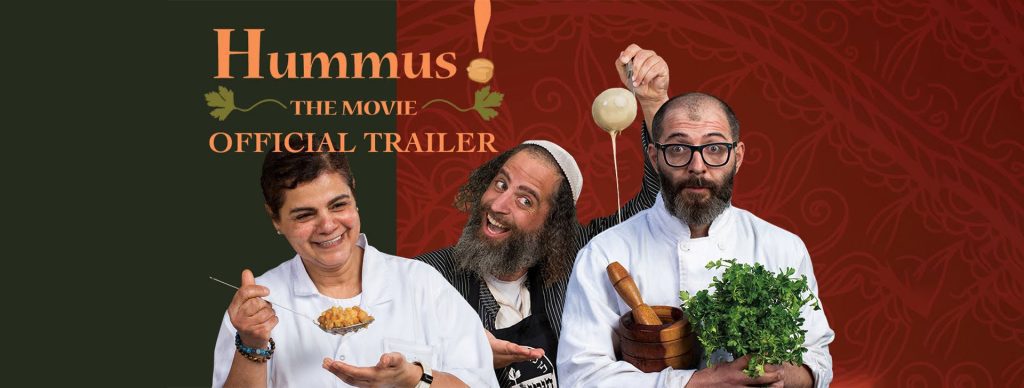
The documentary follows three lives connected by a dish known around the world as hummus.
First, there is Suheila Al Hindi, a Muslim woman who runs a hummus restaurant in Acre (Akko) and became known for her exceptional recipe. Suheila won the Golden Pita Award, competing against ten men.
Then there is Jalil Dabit, a young Arab Christian from Ramla who took over his family’s hummus restaurant and finds himself torn between continuing the family tradition and seeking a different life.
Finally, there is Eliyahu Shmueli, who grew up in a secular and alternative environment before becoming a devout Hasidic Jew and opening successful kosher hummus restaurants.
Alongside these personal stories, Rosenfeld explores the history of hummus, its secret recipes, the fierce competition between restaurants and even the so-called “hummus wars,” revolving around a question that may sound simple but carries centuries of identity and belonging: Is this dish Israeli, Arab or Lebanese?
The documentary also follows attempts to set a Guinness World Record for the largest serving of hummus in the world.
And it is precisely here that a beautiful connection emerges with Laura Esquivel’s Like Water for Chocolate. In that novel, the kitchen becomes the language through which Tita expresses her emotions, her love, her pain and her family history amid the Mexican Revolution.
In Hummus the Movie, Rosenfeld finds in a dish another way of telling a story about life. His protagonists talk about love, family, identity, survival and tradition as they prepare, serve and defend a recipe.
In both cases, food ceases to be simply food. It becomes memory, identity and a way of preserving who we are.
Rosenfeld also presents the deeply rooted machismo of the Middle East in an everyday, relaxed and often humorous way. Male hands come together to give hummus its distinctive flavor and texture, while some men insist that they are better cooks than women.
The great comeback comes with Suheila Al Hindi’s victory, leaving her male competitors “crushed” in a contest for the best recipe.
The kitchen can also be a battlefield. We see something similar today in Colombia’s MasterChef competitions, where assistants, chefs and administrators face one another around a dish. Rosenfeld, however, seems interested in something beyond competition: revealing the human side of hummus.
And to achieve this, he relies on cinematic elements such as photography and music, composed by his friend, Israeli composer and pianist Jonathan Bar-Giora. His score accompanies each of the characters, creating an intimate dialogue with the viewer.
Hummus Means Life
“Hummus is a miracle” and “I’m married to hummus” are among the phrases that emerge naturally from real-life situations and bring us even closer to the protagonists.
Running a restaurant is not easy. Finding ingredients, dealing with debt, coming close to bankruptcy and struggling to survive while supporting a wife and children is, ultimately, a story of survival that can touch anyone.
The dedication of those who choose to keep a recipe alive, sometimes at the cost of sacrificing part of their personal lives, is equally moving.
Suheila, one of the protagonists, puts it with a clarity that needs no further explanation: she does not regret sacrificing her romantic life because, quite simply, hummus is her long-term partner.
That is where the documentary transcends the dish. Rosenfeld takes us through the streets and restaurants of Acre (Akko), Ramla, Yokneam, the United States and even Lebanon. He does so through real people, without artifice or filters, showing the everyday reality of a profession practiced with dedication and love.
Muslims, Christians and Jews ultimately find themselves connected by a recipe. And although Rosenfeld’s favorite hummus is chickpea hummus served with mushrooms, for us, the viewers, its cultural significance goes far beyond a gastronomic preference or the pursuit of a Guinness World Record.
Hummus the Movie personifies a dish that is also very popular in Colombia’s Caribbean region, where it has been given the local name “tajine,” and reminds us that around a table we can find stories capable of crossing religious, political and cultural borders.
Perhaps that is why, as in Laura Esquivel’s work, food here ultimately speaks of what matters most: where we come from, whom we love, which traditions we choose to preserve, and how, despite our differences, we can still sit together at the same table.
Special thanks to: David Rosenthal -Oren Rosenfeld.
Hummus the Movie Trailer