

The Odyssey, attributed to Homer, was composed around the 8th century BCE (roughly between 750 and 700 BCE). Nearly 2,800 years later, this masterpiece of universal literature continues to confront us with enduring questions: the burden of war, the cost of masculine pride, the invisible scars of absence, and the ways love is reshaped by time, silence, and violence. It is not merely an epic tale—it is an unsettling mirror of human nature.
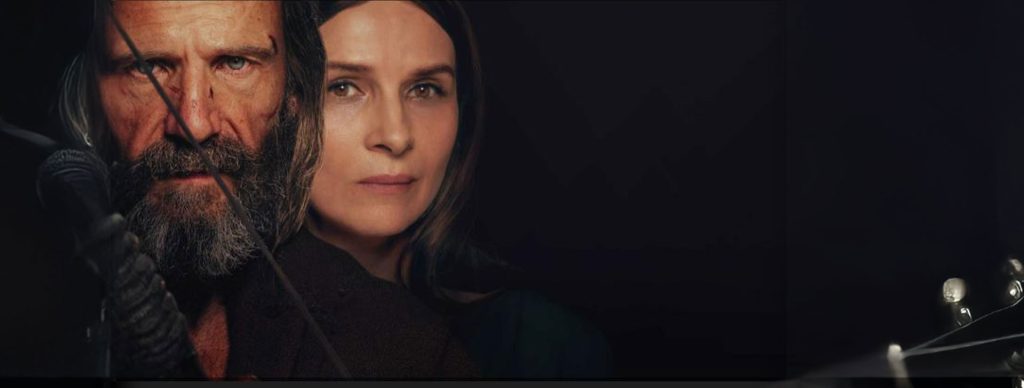
In this spirit comes The Return, starring Ralph Fiennes and Juliette Binoche, a restrained and deeply human reimagining of the final chapters of The Odyssey. Here, Odysseus does not return as a triumphant hero, but as a broken man. After twenty years of war and wandering, he arrives in Ithaca to find his home in ruins, Penelope surrounded by suitors, and his son Telemachus in danger. Gone are the gods and grand interventions—his struggle is now strategic, internal, and profoundly moral.
“Why do men go to war?” Penelope asks. Odysseus’ answer is disarmingly honest: “I can’t explain it, because I don’t even understand it myself.” In that exchange lies the emotional core of the film. Fiennes delivers a powerful portrayal of a man marked not only by physical wounds, but by those that never heal. War has transformed him—numbing his emotions, stripping away his sense of identity, leaving behind only fragments shaped by blood, sacrifice, and loss. His return is not a victory, but the beginning of another battle: confronting his own fragility, the collapse of his ego, and the loss of meaning.
The film, directed by Umberto Pasolini, insists on a difficult truth: victory often looks like grief. And as Odysseus himself suggests, “war is everywhere.”
That idea resonates strongly in today’s world. According to organizations such as the Uppsala Conflict Data Program and the Institute for Economics and Peace, there are currently between five and seven high-intensity wars worldwide, alongside roughly 50 to 60 active armed conflicts—including civil wars—and more than 100 situations involving organized violence or prolonged tensions. Among the most visible are the war in Ukraine, the Israeli–Palestinian conflict, the Syrian civil war, the conflict in Sudan, and the war in Yemen.
Beyond these, fragile ceasefires and simmering tensions continue to shape a world deeply marked by violence, further exacerbated by rising frictions between Iran and the United States and by the strategic importance of the Strait of Hormuz, a critical artery for global energy flows. This is without even mentioning the conflict in Lebanon, where Hezbollah remains entangled in a volatile and deeply fragmented landscape that underscores the persistence of instability worldwide.
Within this context, The Return feels strikingly contemporary. At its heart lies a powerful contrast between two ways of confronting conflict and exercising leadership. Penelope embodies restraint: she seeks to preserve peace by avoiding direct confrontation, maintaining a fragile balance without imposing rigid rules, trusting that patience can sustain order. Odysseus, however, represents a different philosophy: without authority and force, he suggests, there can be no respect. To reclaim Ithaca, he believes decisive action is necessary—even if it requires violence.
This tension echoes in our own reality: should we endure through tolerance, or act before everything collapses? The film offers no easy answers, but it compels us to confront the question.
Some absences never end.
Penelope emerges as the true moral center of the story. Her waiting is not passive—it is shaped by intelligence, strategy, and unshakable dignity. Yet it is also marked by idealization. She remains faithful to a man who no longer exists as she remembers him, holding onto the memory of who he was before the war. Love, in the film, becomes an act of endurance: loyalty, hope, and patience in the face of time.
Binoche’s performance is extraordinary. With minimal dialogue, she conveys everything through her gaze—pain, clarity, irony, restraint, and quiet disappointment. Because the reunion is not only emotional, but disillusioning. Penelope must confront not just absence, but transformation. She must process the symbolic loss of the man she loved, while navigating solitude and the social pressure of waiting for someone who might never return.
In a world where relationships often feel immediate and fragile—where patience is scarce and expectations demand instant fulfillment—Penelope’s character feels almost radical. How long are we willing to wait? What does it truly mean to remain?
Paradoxically, while Odysseus is the one who returns physically, it is Penelope who has truly endured. She embodies fidelity, intelligence, resilience, and emotional strength. She sustains meaning. She redefines love beyond presence. At the same time, she undertakes a difficult journey toward forgiveness: first marked by denial, rejection, and anger, and ultimately, as she gently traces the physical wounds on her husband’s body, she begins to grasp the deeper dimension of the wounds within his soul.
The Return reminds us that Homer’s work does not belong to the past. It continues to offer a powerful lens through which to understand the present. Perhaps he never imagined that his story would resonate so precisely with a world like ours—fragmented, violent, and still searching for redemption.